

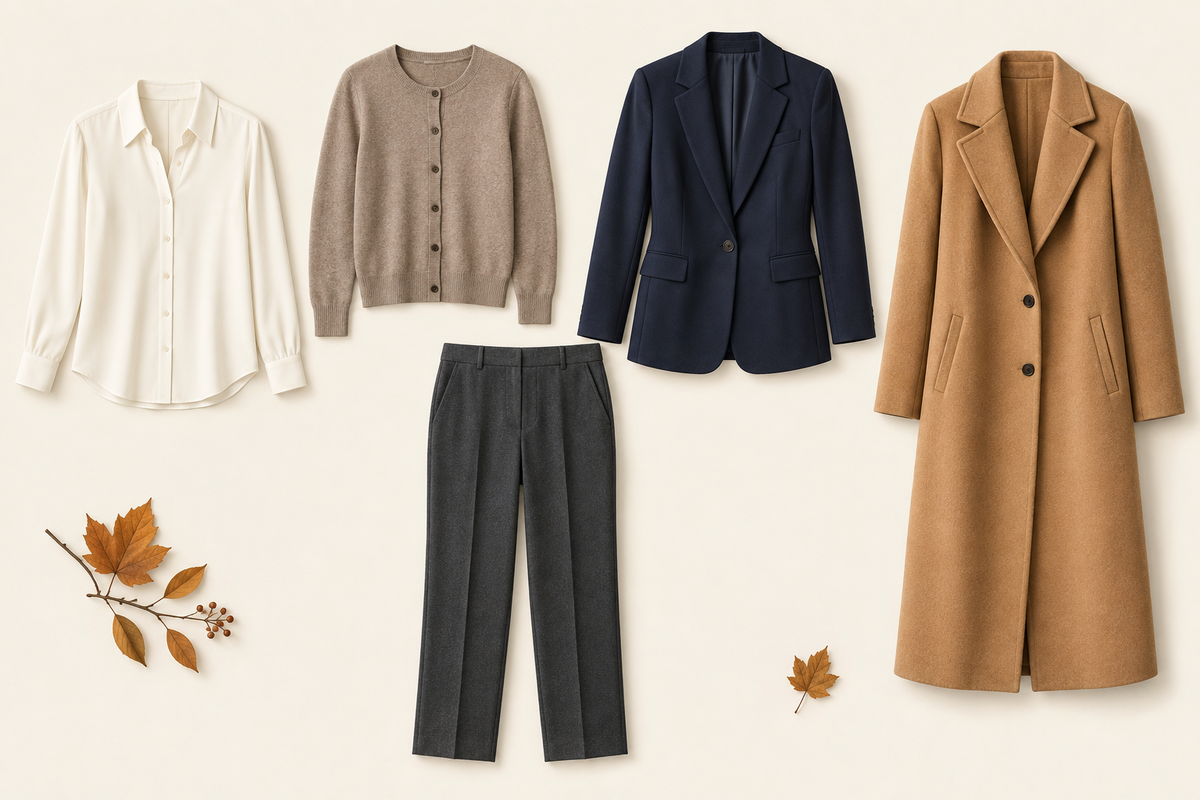
Layering autumn workwear is most useful when each piece has a clear job: a base outfit suitable for your workplace, a removable indoor layer, and outerwear chosen for your commute. You do not need to wear every layer all day, or buy an entirely new outfit when the temperature changes.
Start with what you own and test the combinations together. A cardigan that feels comfortable on its own may fit differently beneath a jacket, especially through the shoulders and sleeves.
Start with an office-appropriate base outfit
Choose a top and trousers or skirt, or a dress, that meet your workplace's dress code without relying on a jacket to complete them. This lets you remove an indoor layer when the office is warm.
Before adding anything, sit down, reach forward, and walk in the base outfit. Check that the neckline, sleeve coverage, hemline, and fit still suit your working day. A base you need to adjust constantly will not become easier to wear just because you put a blazer over it.
Give your indoor and outdoor layers different jobs
A removable layer for the office
A cardigan, knit, or blazer can help you adapt to changing indoor temperatures. Choose the one that suits your dress code and fits over your base top. An open-front or buttoned layer can be easier to remove at your desk than a close-fitting pullover.
If you use a pullover, consider how you will put it on and take it off, and whether the top underneath works independently. You do not need both a cardigan and a blazer in every outfit.
Outerwear for your journey
A coat or other outer layer should suit the conditions you expect outside and fit over the clothes you will actually wear beneath it. Check product information for stated weather protection: an autumn color or a long silhouette does not establish that a garment is waterproof or sufficiently warm for your climate.
For seasonal browsing, explore Autumn Theory, then evaluate each garment's listed materials, measurements, and care details against your needs.
Check the fit of the complete combination
Try the base, indoor layer, and outerwear together before a working morning. Pay attention to these points:
- Shoulders and upper arms: Can you reach forward without pulling or restriction?
- Sleeves: Do they sit comfortably, rather than bunching inside the next layer?
- Closures: Can you fasten the jacket or coat without compressing the clothes beneath it?
- Lengths: Are shirt tails, cardigan hems, and jacket lengths arranged in a way you like?
- Daily tasks: Can you sit, carry your bag, and move through your commute comfortably?
Do not automatically buy a larger size to make layers fit. Compare the garment's measurements with clothes you already wear successfully, and check its intended fit. If the listing lacks an important measurement, ask before ordering.
Three layering combinations to try
For a chilly morning and a warmer office
Start with trousers and a blouse that works on its own. Add a cardigan for the journey, plus appropriate outerwear if the conditions require it. Remove the outdoor layer when you arrive and keep or remove the cardigan according to how the office feels.
For a day with meetings
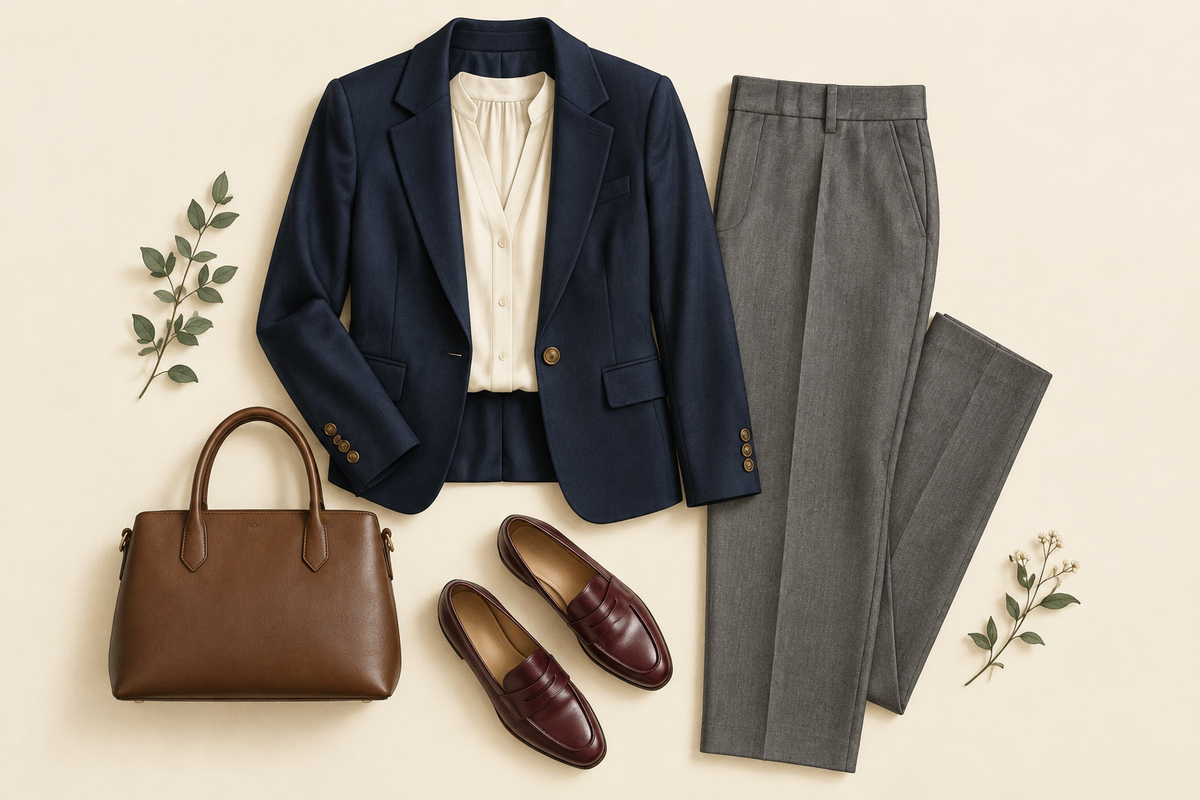
Combine a simple dress-code-appropriate top and trousers with a blazer. Use separate outerwear for the commute where needed. If your meetings call for a jacket, test whether the blazer is comfortable for the time you expect to wear it, rather than relying on removing it.
For colder conditions
Try a suitable top with a knit or cardigan and an outer layer that accommodates both. Choose footwear appropriate for the journey and consider a removable scarf where practical. Check workplace safety rules around loose accessories. Let the expected conditions determine what you need, rather than assuming three layers are always enough.
Browse The Workday Edit for separates and layers to compare with your existing outfits. Treat these combinations as styling ideas, not a claim that a particular product will provide a specific level of warmth.
Avoid common layering problems
Too much volume through the sleeves
If a roomy blouse feels cramped beneath a close-fitting knit, try a different pairing before buying another garment. Either use a top that fits comfortably beneath that layer or choose a layer that accommodates the blouse. Check the complete outfit, not each item's size label alone.
An outfit that only works with the jacket on
If you expect to remove the jacket, make sure you are happy with the base underneath. Plan that version of the outfit first, so changing temperature does not leave you uncomfortable or outside your dress code.
More layers than you want to carry
Consider where a removed cardigan, coat, or scarf will go. If your commute involves walking or public transport, a combination with fewer removable pieces may be more practical. Choose based on your routine rather than the appearance of a styled outfit.
Use existing colors to make layers interchangeable
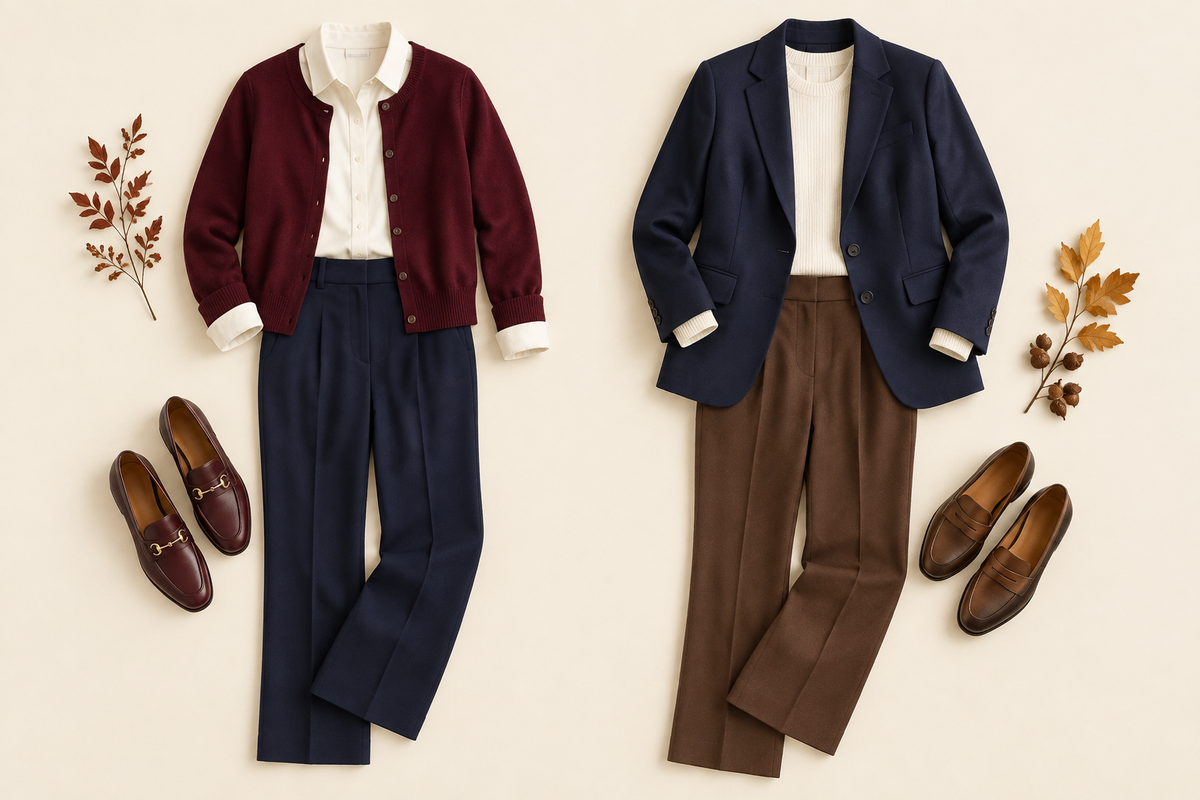
Start with the colors in your usual trousers, skirts, and tops. A navy blazer might work with cream and gray pieces you already own; a taupe cardigan might suit your brown or navy outfits. Try the combinations in daylight rather than assuming all neutrals work together equally well.
Repeating a useful layer across several outfits is a practical way to build a smaller wardrobe. Buy another only when you can identify a gap the current pieces do not cover.
Questions about layering autumn workwear
Can I wear a cardigan under a blazer?
Yes, if the combination meets your dress code and fits comfortably. Check sleeve space, shoulder movement, and whether the blazer closes as intended. If the pairing feels restrictive, use one indoor layer or try a different combination.
How many layers do I need for autumn?
There is no fixed number. Your climate, commute, office temperature, and clothing determine what is useful. Start with a suitable base and add removable pieces according to the conditions you expect.
What should I check before buying a workwear layer online?
Check measurements, listed materials, intended fit, care instructions, and any stated weather-protection details. Compare those with garments you already own. Do not infer warmth, breathability, or water resistance from the photograph alone.
Reading next
- How to Build an Autumn Workwear Capsule Wardrobe explains how to coordinate layers with the rest of your working wardrobe.
- Business Casual Autumn Outfits: Practical Ideas for the Working Week offers outfit formulas to adapt to your workplace.
The featured image is an illustrative layering concept, not a photograph of specific Moderne products.

Leave a comment
This site is protected by hCaptcha and the hCaptcha Privacy Policy and Terms of Service apply.