
A workwear capsule color palette is a group of colors that helps your clothes work together. Start with the pieces you already wear most, identify combinations you like, and add a new color only when it makes those outfits more useful. You do not need an all-neutral wardrobe or a fixed number of shades.
The goal is easier outfit planning, not replacing good clothes because they do not match a prescribed palette.
Find the colors already doing the work
Take out your most-used work trousers, skirts, tops, dresses, layers, and shoes. Focus on pieces that fit comfortably and meet your workplace's dress code.
Look for repeated colors among your bottoms and layers. If navy trousers and a gray jacket already appear in several outfits, use those as a starting point. Your preferred base might instead be brown, black, or a color you enjoy wearing regularly.
Lay the clothes together and note which combinations you actually like. A color that appears often in your wardrobe is not automatically one you want to build around, especially if the garments rarely get worn.
Choose a base before adding accents
A base color gives several outfits something in common. Neutrals such as navy, gray, black, brown, and cream can be useful starting points, but you do not need all of them.
Choose according to your existing clothes and preferences. If you rarely wear black, there is no need to buy black pieces simply because capsule lists often include them. Equally, a colorful wardrobe can be coordinated without being converted into beige and navy.
Three workwear palettes to try
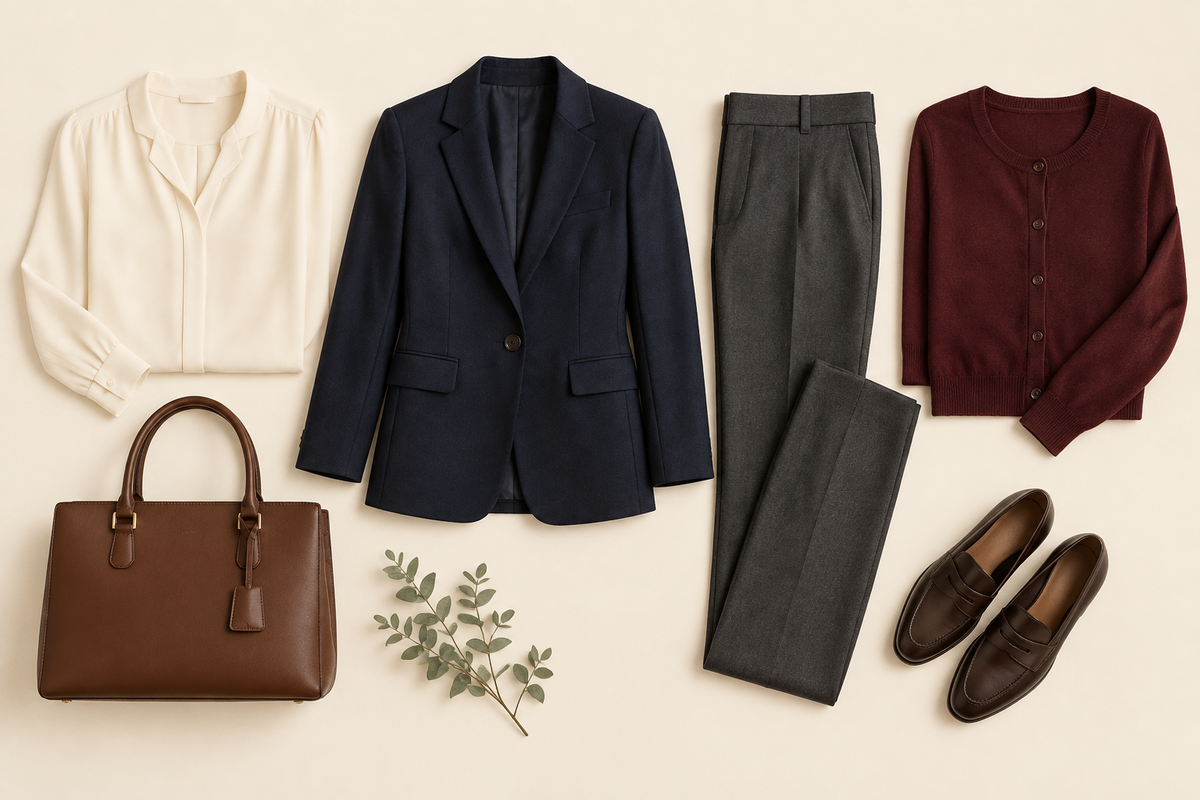
Navy, cream, and burgundy
Try navy trousers with a cream blouse and a burgundy cardigan. The cardigan acts as an accent while the trousers and blouse provide a repeatable base. If you already have a navy blazer, compare it with the same blouse and trousers as another option.
Gray, black, and cream
Try gray trousers, a cream top, and a black jacket. Use shoes you already wear comfortably and assess the complete outfit. Different gray tones and fabric finishes can look quite different together, so check actual garments rather than relying on their color labels.
Brown, cream, and navy
Try brown trousers with a cream top and a navy layer. If your usual bag or shoes are brown, include them in the comparison rather than buying new accessories immediately. The brown shades do not need to be identical, but choose a combination you like in person.
These are styling examples, not a requirement to own every pictured piece or a claim that every shade in a color family will coordinate.
Use an accent where you want it
An accent can come from a blouse, cardigan, scarf, bag, or other item you use. Burgundy is one option for autumn, but it is not compulsory or a trend claim. Choose a color you like and can wear with your existing combinations.
Try one accent piece with several outfits before adding more clothes in the same shade. If it only works with one outfit, decide whether that is useful enough for you rather than assuming you must buy matching pieces.
Keep useful prints
A printed blouse or skirt can remain part of a capsule if it works with your other clothes. Look at the colors in the print and try an existing solid piece alongside it. For example, a print containing navy may be worth testing with navy trousers or a jacket.
You do not have to match every color in a print. Compare the scale and overall effect with your layers, and use workplace rules to decide whether the combination suits the setting.
Check real garments, not just color names
Two items labeled navy, cream, or brown may differ in shade. Online photographs and your screen can also make comparisons uncertain. Where possible, compare the garments together in daylight and under the light you normally dress in.
- Try the colors with the actual shoes and bag you will use.
- Check whether a shiny, textured, or matte finish changes the combination in a way you like.
- Look at the outfit both with and without the outer layer.
- Take a reference photo of combinations that work, while remembering that photos can shift colors too.
If matching an existing garment closely is essential, ask for available color information before ordering and check the return conditions. A shared color name is not a guarantee of an exact match.
Use your palette as a shopping filter
Identify the missing role first, such as a top that works under your usual jacket. Then use your palette to narrow the options. A piece in the right color still needs to fit, meet your dress code, and have a manageable care routine.
Explore The Workday Edit for workwear ideas or the Clothing collection for broader options. Check individual product information rather than assuming a color or collection name establishes suitability.
Do not reject a useful item you already own just because it sits outside the main palette. You can keep a separate outfit you enjoy without making every piece interchangeable.
A quick palette-planning checklist
- Which colors are in the work clothes I actually wear?
- Which bottoms and layers already combine well?
- Can I make complete outfits with my current tops, shoes, and bag?
- Would an accent add something I want, or just create another shopping list?
- Have I compared the actual shades and finishes where possible?
- Does any proposed purchase fill a real wardrobe gap?
Questions about workwear capsule colors
How many colors should a workwear capsule have?
There is no fixed number. Use enough variety to enjoy your clothes while keeping outfit planning manageable. Your existing combinations are a better guide than a target count.
Can I wear black and navy together?
Yes, if you like the combination and it suits your workplace. Try the actual garments together, since their shades and finishes affect the result. You do not need to avoid a pairing solely because of a rigid color rule.
Do my shoes and handbag need to match?
Not necessarily. Try them with the complete outfit and choose a combination you like. Exact matching is not a prerequisite for a coordinated wardrobe.
Should I change my whole palette for autumn?
No. Keep useful clothes and adapt layers or combinations for the weather. Add a seasonal accent only if you want it and it works with your wardrobe; a change of season does not require a new set of colors.
Reading next
- How to Build an Autumn Workwear Capsule Wardrobe connects your palette with essentials, layers, and outfit planning.
- How to Build a Workwear Capsule Wardrobe on a Budget helps prioritize gaps without replacing your existing clothes.
The featured image is an illustrative color-palette concept, not a photograph of specific Moderne products.


Leave a comment
This site is protected by hCaptcha and the hCaptcha Privacy Policy and Terms of Service apply.